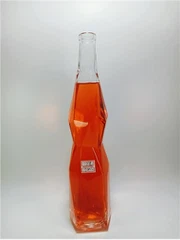
Tang Dynasty Melon Shaped Glass Bottle With Handle
Mar 09, 2023
The Han Dynasty began to see the emergence of glass containers, such as glass plates with a diameter of more than 19 centimeters and glass ear cups with a length of 13.5 centimeters and a width of 10.6 centimeters unearthed from the tomb of Liu Sheng in Mancheng, Hebei. During the Han Dynasty, transportation between China and the West was developed, and foreign glass was likely to be introduced into China. Three pieces of purple and white glass fragments were unearthed from a tomb of the Eastern Han Dynasty in Qiongjiang County, Jiangsu Province. After restoration, they were a flat bottom bowl decorated with convex ribs. Their composition, shape, and tire stirring techniques were all typical Roman glass ware, which is physical evidence of the introduction of Western glass into China. In addition, blue plate glass plaques have also been unearthed from the tomb of the Nanyue King in Guangzhou, which have not been seen elsewhere in China.
During the Wei, Jin, and Southern and Northern Dynasties, Western glassware was imported into China in large quantities, and the technology of blowing glass was also introduced. Due to innovative changes in composition and technology, glass containers at this time were larger, their walls thinner, and transparent and smooth. Glass convex lenses were also unearthed from the ancestral tomb of Cao Cao in Bo County, Anhui Province; Glass bottles were unearthed at the base of the Northern Wei Buddha Tower in Dingxian County, Hebei Province; Many polished glass cups were also unearthed from the Eastern Jin Dynasty tomb in Xiangshan, Nanjing, Jiangsu Province. The most exciting thing is the glass ware unearthed from the Sui and Li Jingxun tombs in Xi'an, Shaanxi. There are 8 pieces in total, including flat bottles, round bottles, boxes, egg-shaped vessels, tubular vessels, and cups, all intact.
During the Eastern Zhou Dynasty, the shape of glass objects increased, and in addition to ornaments such as tubes and beads, wall shaped objects, as well as sword tubes, sword ears, and sword rings, were also found; Glass seals have also been unearthed in Sichuan and Hunan. At this time, the texture of the glass is relatively pure, with colors such as white, light green, cream yellow, and blue; Some glass beads are also colored to resemble dragonfly eyes. For example, 73 dragonfly eye type glass beads, each with a diameter of about one centimeter, were unearthed from the Tomb of Zeng Marquis Yi in Suixian County, Hubei Province. White and brown glass patterns are embedded in the blue glass sphere. The academic community once analyzed the composition of glass beads and glass walls in the mid and late Warring States period, and found that most of these glassware were composed of lead oxide and barium oxide, which were different from the composition of ancient glass in Europe, West Asia, and North Africa. Therefore, the academic community believed that they might have been made locally in China.